
PCA - ARN Task Force
Rosin CLH
The PCA is diligently working with HARRPA and H4R on the ongoing classification and labeling assessment of rosin and rosin derivatives. We will continue to share information to our members as it becomes available.
The resource explains the scientific evidence supporting the industry's position, the potential regulatory and socioeconomic implications of classification, and the anticipated timeline for a final European Commission decision. It also addresses common questions from downstream users and opportunities for continued industry engagement.
Read the Q&A here.
Following ECHA's September 2026 Risk Assessment Committee (RAC) meeting, HARRPA, PCA and H4R have issued a joint statement expressing their continued disagreement with the recommended reproductive toxicity classifications for rosin and selected derivatives.
While acknowledging progress in reducing the proposed classification severity for two substances, the organizations reaffirm their commitment to a science-based outcome and continued engagement throughout the European Commission's decision-making process in 2027.
HARRPA, the H4R Consortium, and the Pine Chemicals Association International (PCA) have issued a joint statement following the RAC CLH Working Group's draft recommendations on the proposed classification of rosin and selected rosin derivatives.
The statement acknowledges progress, including the removal of the proposed Category 1B reproductive toxicity classification for rosin and rosin maleated, while reaffirming the industry's position that the available scientific evidence supports no classification for these substances (with the exception of rosin maleated). It also outlines the next steps in the EU regulatory process and the organizations' continued commitment to providing scientific and socio-economic evidence throughout the evaluation.
HARRPA, the H4R Consortium, and the Pine Chemicals Association International (PCA) have released a joint update on the ongoing EU Classification, Labelling and Packaging (CLH) process for rosin and selected rosin derivatives.
The communication outlines new scientific evidence submitted to ECHA supporting the conclusion that the reproductive effects observed in earlier regulatory studies are attributable to maternal undernutrition rather than an inherent hazard of rosin. It also provides an update on the regulatory timeline, potential industry impacts, and the organizations' continued engagement throughout the evaluation process.
The H4R Consortium is pleased to announce the publication of a new peer-reviewed scientific paper examining the reproductive toxicity assessment of rosin and its derivatives.
Authored by Théo Le Godec, Larry Higgins, Mike Penman, and Michael McMahon, the study presents a scientific framework for distinguishing substance-related reproductive effects from those resulting from maternal undernutrition in regulatory toxicity studies.
Supported by the H4R Consortium and the Pine Chemicals Association International (PCA), the research uses rosin (EC 232-475-7) as a case study. Rosin is currently under evaluation by the European Chemicals Agency's (ECHA) Risk Assessment Committee (RAC) as part of the ongoing harmonized classification process for reproductive toxicity.
Through enhanced statistical evaluation and additional mechanistic data, the authors conclude that the reproductive findings reported in earlier regulatory studies are more consistent with the effects of maternal undernutrition than with an intrinsic reproductive hazard of rosin or its derivatives.
The study represents an important contribution to the scientific discussion surrounding the current CLH proposal and may provide valuable insight for toxicologists evaluating similar challenges in reproductive toxicity testing.
Read the full article here.
|
HARRPA, the H4R Consortium, and the Pine Chemicals Association have submitted joint scientific comments to ECHA on the proposed reproductive toxicity classifications for rosin and certain derivatives. Our review, including newly commissioned studies, concludes that most proposed classifications are not warranted, as observed effects appear related to maternal undernutrition rather than intrinsic hazard. One substance may warrant further evaluation at a lower classification category. With hazard comments submitted, the next phase focuses on collecting accurate use and exposure data and assessing potential socio-economic impacts. Update Letter: 2025 November: HARRPA_H4R_PCA Joint Communications Update |
- the outcome of the two new investigative studies sponsored by H4R and PCA, which provide evidence to support our position that none of these substances raise concern for reprotoxicity hazard and therefore do not meet the criteria for classification.
- information about the use of the substance, including its essentiality and critical technical function in your applications, exposure conditions and risk management measures currently in place.
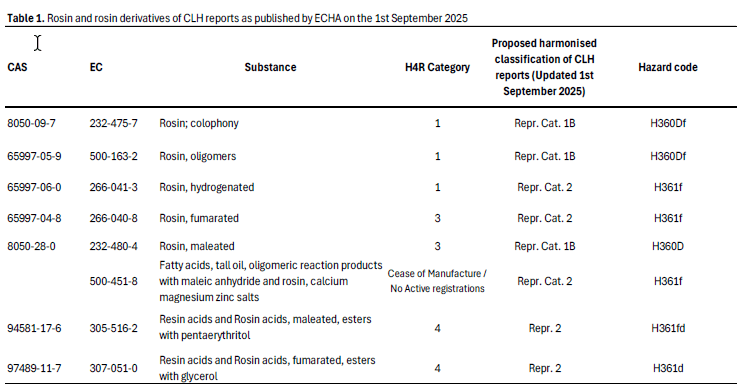
In August 2023, ECHA published an Assessment of Regulatory Needs (ARN) document for Rosin and its derivatives. This ARN has subsequently led to a Harmonized Classification and Labelling (CLH) assessment on the substances by the Norwegian Environmental Protection Agency (the national Member State Competent Authority [MSCA] on REACH in Norway). Norway has registered its intentions to propose CLH for reprotox for 9 specific rosin and rosin derivative substances (8 managed by H4R Consortium). At the moment it is unclear what the basis is for the proposed CLH by Norway, especially since reprotox classification is not warranted based on the available scientific evidence on these substances.
PCA disagrees strongly with these proposed classifications, since, based on the available toxicological data, none of these substances raise any concern for reprotox hazard and therefore they do not meet the criteria for classification.
A formal PCA position paper is available, which provides the background necessary to understand the reasons for PCA’s position on this issue and is also intended to share some insights on the next possible steps. The paper can be downloaded here.
Note that PCA will update its stakeholders when significant developments occur and is willing to organize specific informative sessions to provide detailed information on any of the aspects of this case. For further inquiries, please reach out to office@pinechemicals.org.
Note that PCA will update its stakeholders when significant developments occur and is willing to organize specific informative sessions to provide detailed information on any of the aspects of this case. For further inquiries, please reach out to office@pinechemicals.org.
The PCA is preparing to host a webinar on this issue for all stakeholders. Once the date and time are established, emails will be sent with those details.
Note that PCA will update its stakeholders when significant developments occur and is willing to organize specific informative sessions to provide detailed information on any of the aspects of this case. For further inquiries, please reach out to office@pinechemicals.org.
The PCA is preparing to host a webinar on this issue for all stakeholders. Once the date and time are established, emails will be sent with those details.
Note that PCA will update its stakeholders when significant developments occur and is willing to organize specific informative sessions to provide detailed information on any of the aspects of this case. For further inquiries, please reach out to office@pinechemicals.org.
The PCA is preparing to host a webinar on this issue for all stakeholders. Once the date and time are established, emails will be sent with those details.