
CLASSEN Develops Technology
Date postedSeptember 23, 2026
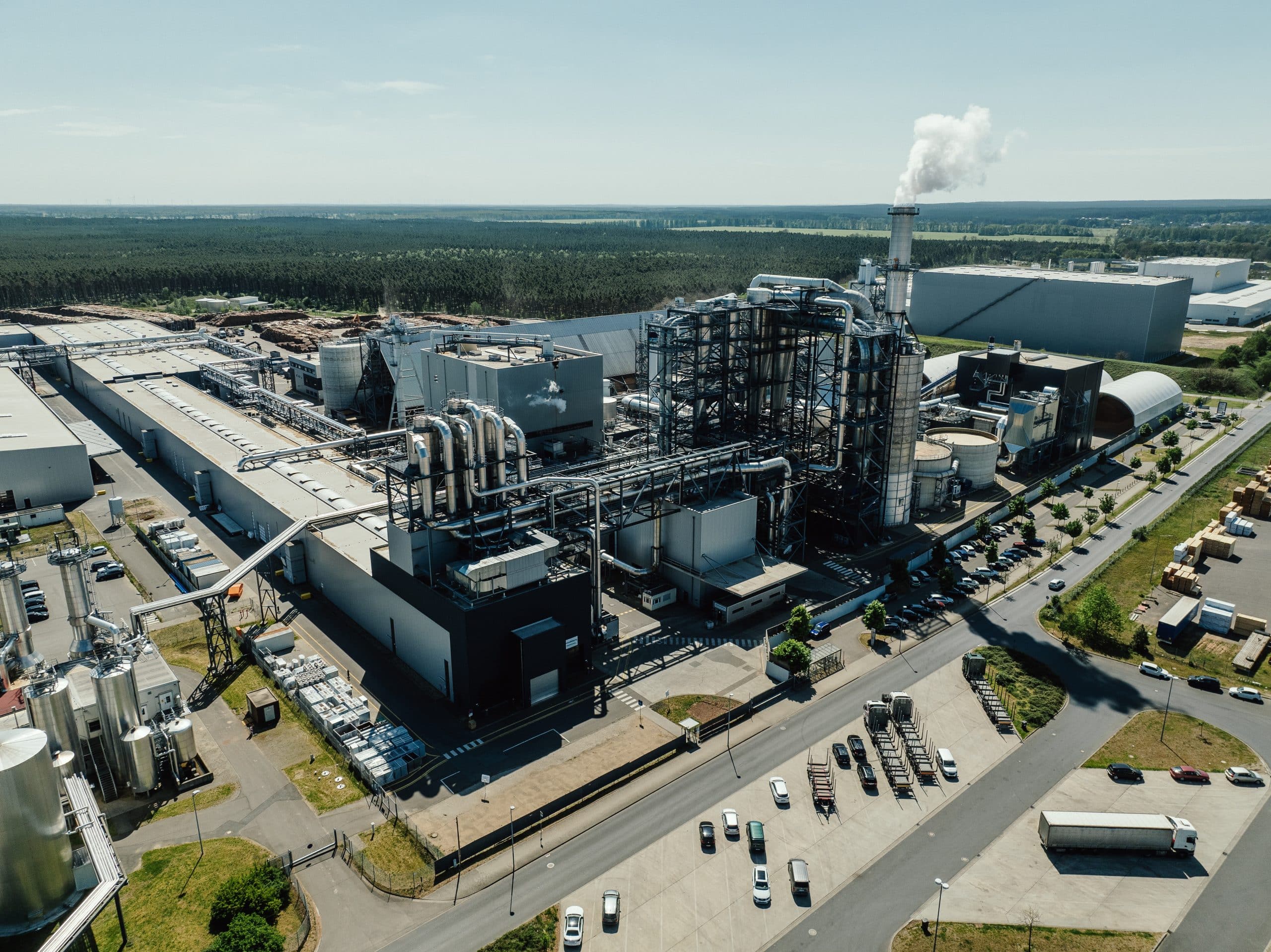
New plant at the Baruth site is expected to recover up to 1,200 metric tons per year while reducing emissions
Baruth/Mark, September 7, 2026. At its Baruth site, the CLASSEN Group is investing in a new plant for the recovery of turpentine from MDF production. The plant is currently under construction and is scheduled to go into operation at the end of 2026. In the future, it will be able to recover up to 1,200 metric tons of terpenes per year and supply them as a raw material for industrial applications. At the same time, the process developed by CLASSEN helps to significantly reduce terpene emissions during the processing of pine wood.
Baruth/Mark, September 7, 2026. At its Baruth site, the CLASSEN Group is investing in a new plant for the recovery of turpentine from MDF production. The plant is currently under construction and is scheduled to go into operation at the end of 2026. In the future, it will be able to recover up to 1,200 metric tons of terpenes per year and supply them as a raw material for industrial applications. At the same time, the process developed by CLASSEN helps to significantly reduce terpene emissions during the processing of pine wood.
Pine wood naturally contains essential oils known as terpenes. During the production of MDF, heat causes these substances to be released from the wood. Until now, some of them have been released into the atmosphere along with the exhaust air from the drying process.
However, terpenes are not only responsible for the characteristic odor of pine wood and resin. As volatile organic compounds (VOCs), they can participate in chemical reactions in the atmosphere that lead, among other things, to the formation of ground-level ozone. Reducing these emissions therefore poses a technical challenge for the wood-based materials industry.
With the European emission requirements—known as BAT-AEL values—that have been in effect since 2016, the standards for industrial facilities have been further specified. BAT-AEL stands for emission levels associated with best available techniques. Compliance with these standards is particularly challenging when processing pine wood, as terpenes are only very slightly water-soluble and can therefore be captured only to a limited extent using conventional wet exhaust gas scrubbing systems.
CLASSEN, too, initially applied for an exemption. At the same time, however, the family-owned company began developing its own technological solution at an early stage.
However, terpenes are not only responsible for the characteristic odor of pine wood and resin. As volatile organic compounds (VOCs), they can participate in chemical reactions in the atmosphere that lead, among other things, to the formation of ground-level ozone. Reducing these emissions therefore poses a technical challenge for the wood-based materials industry.
With the European emission requirements—known as BAT-AEL values—that have been in effect since 2016, the standards for industrial facilities have been further specified. BAT-AEL stands for emission levels associated with best available techniques. Compliance with these standards is particularly challenging when processing pine wood, as terpenes are only very slightly water-soluble and can therefore be captured only to a limited extent using conventional wet exhaust gas scrubbing systems.
CLASSEN, too, initially applied for an exemption. At the same time, however, the family-owned company began developing its own technological solution at an early stage.
Reducing Emissions Directly in the Production Process
This was based on extensive operational and emissions data from the MDF plant in Baruth. Through systematic analysis of this data, CLASSEN was able to identify a point in the production process where terpenes become highly concentrated in a vapor stream.
The developed process therefore does not begin with exhaust air purification. Instead, the terpene-enriched steam is specifically extracted in the high-pressure section of the MDF process. In this way, a large portion of the terpenes can be removed from the rest of the production process.
This process has been in use at the Baruth site for more than three years. To date, the extracted vapor has been used to generate energy at the power plant. According to CLASSEN, this has resulted in relevant emission levels that are more than 50 percent below the applicable limits. Due to the technological maturity achieved, the company withdrew its application for an exemption in 2024.
The developed process therefore does not begin with exhaust air purification. Instead, the terpene-enriched steam is specifically extracted in the high-pressure section of the MDF process. In this way, a large portion of the terpenes can be removed from the rest of the production process.
This process has been in use at the Baruth site for more than three years. To date, the extracted vapor has been used to generate energy at the power plant. According to CLASSEN, this has resulted in relevant emission levels that are more than 50 percent below the applicable limits. Due to the technological maturity achieved, the company withdrew its application for an exemption in 2024.
Emissions reduction turns into raw material extraction
With the new facility, CLASSEN is now taking things a step further. Instead of using the terpene-rich steam solely for energy, it will be condensed in the future. The turpentine it contains—a mixture of various natural terpenes from pine wood—can then be separated.
The process is designed to minimize impurities as much as possible, thereby producing an industrially usable raw material. At the same time, the heat contained in the vapor is recycled back into the production process.
At full capacity, up to 1,200 metric tons of terpenes are expected to be produced annually in Baruth. These terpenes have various industrial applications. For example, terpenes can be used as raw materials for fragrances and flavorings, camphor, or menthol, as well as for additives in the tire industry. In addition, they are being investigated or used as potential biogenic feedstocks for the production of Sustainable Aviation Fuel (SAF).
In this way, the process combines two previously separate tasks: reducing emissions from MDF production and extracting a raw material from a material stream that had not previously been utilized.
The process is designed to minimize impurities as much as possible, thereby producing an industrially usable raw material. At the same time, the heat contained in the vapor is recycled back into the production process.
At full capacity, up to 1,200 metric tons of terpenes are expected to be produced annually in Baruth. These terpenes have various industrial applications. For example, terpenes can be used as raw materials for fragrances and flavorings, camphor, or menthol, as well as for additives in the tire industry. In addition, they are being investigated or used as potential biogenic feedstocks for the production of Sustainable Aviation Fuel (SAF).
In this way, the process combines two previously separate tasks: reducing emissions from MDF production and extracting a raw material from a material stream that had not previously been utilized.
Potential Beyond the Baruth Location
CLASSEN sees particular potential in this technology for MDF plants with a high proportion of pine wood. This is because the challenge posed by terpene emissions affects not only the Baruth site but also numerous production facilities in the international wood-based materials industry.
In addition to reducing emissions, recovery can also be economically viable: the separated turpentine can be marketed as a raw material. According to CLASSEN’s calculations, the necessary plant technology can pay for itself within about two to three years—depending on the type of pine used, the composition of the recovered turpentine, and the specific conditions at the production site.
CLASSEN is therefore already working on the international marketing and licensing of the developed MDF-T technology. Initial discussions regarding the implementation of the process are already underway.
With the new plant set to begin operations at the end of 2026, Baruth is poised to become more than just a production site for an additional raw material. CLASSEN also aims to demonstrate how emissions reduction and raw material extraction can be combined within existing industrial processes.
Contacts:
Sebastian Wendel
CLASSEN Group
Wendel@classen.de
In addition to reducing emissions, recovery can also be economically viable: the separated turpentine can be marketed as a raw material. According to CLASSEN’s calculations, the necessary plant technology can pay for itself within about two to three years—depending on the type of pine used, the composition of the recovered turpentine, and the specific conditions at the production site.
CLASSEN is therefore already working on the international marketing and licensing of the developed MDF-T technology. Initial discussions regarding the implementation of the process are already underway.
With the new plant set to begin operations at the end of 2026, Baruth is poised to become more than just a production site for an additional raw material. CLASSEN also aims to demonstrate how emissions reduction and raw material extraction can be combined within existing industrial processes.
Contacts:
Sebastian Wendel
CLASSEN Group
Wendel@classen.de